








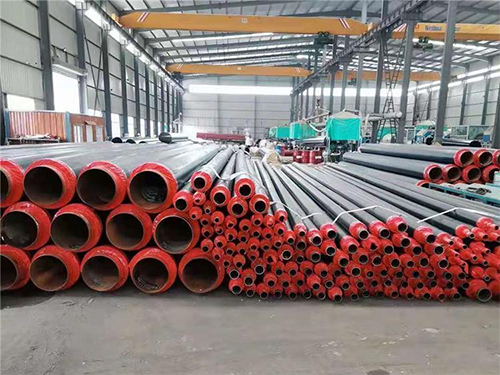
1、 Core Definition and Product Positioning
Galvanized iron sheet overhead insulation steel pipe is a standardized insulation product designed for laying pipelines on the ground or overhead. It is prefabricated in the factory from working steel pipes, effective insulation layers, and galvanized iron sheet protective layers. This product is mainly used for pipeline systems that are not suitable for direct burial or require regular maintenance. It is a solution for industrial plants, petrochemical equipment, and urban thermal pipeline overhead sections.
Its core feature is the use of galvanized steel sheet as the outer protective layer, which combines excellent mechanical strength, rain and sun resistance, and long-term performance stability, while maintaining a beautiful and neat appearance. It is particularly suitable for places such as industrial parks, public buildings, and outdoor pipeline corridors that require safety and aesthetics.
2、 Detailed three-layer structural analysis
1. Working steel pipe (pressure conveying layer)
Material: Select seamless carbon steel pipes (for transporting steam and hot water), stainless steel pipes (for corrosive media), or alloy steel pipes (for high temperature and high pressure) according to the characteristics of the medium.
Processing technology: The inner wall can be coated (such as epoxy resin), and the outer surface can be shot blasted to achieve Sa2.5 level rust removal.
Standard specifications: Strictly follow the GB/T 8163 (seamless pipe) or GB/T 9711 (welded pipe) standards.
2. Effective insulation layer (insulation core)
Material system:
Medium low temperature type (≤ 350 ℃): Centrifugal glass wool or rock wool, density 80-120kg/m ³, thermal conductivity 0.035-0.044 W/(m · K).
High temperature type (350 ℃ -600 ℃): Aluminum silicate fiber blanket, temperature resistance grade 1260 ℃, multi-layer staggered wrapping.
Special requirement type: microporous calcium silicate, temperature resistant to 650 ℃, used for load-bearing support parts.
Process key:
Layered staggered joints: When using multi-layer insulation, the joints of each layer should be staggered by ≥ 100mm, and all direct thermal bridges should be eliminated.
Dense filling: The compression rate of the insulation layer is 15% -20%, and it is confirmed that there is no looseness or settlement.
(Based on actual reports) Processing: Lay an aluminum foil layer (based on actual reports) between the insulation layer and the outer protective layer (in high humidity environments).
3. Galvanized iron sheet protective layer (external protection system)
Substrate: Galvanized steel plate, zinc layer weight ≥ 180g/m ² (Z180), thickness 0.5-1.2mm.
Molding process:
Spiral bite: One on one equipment continuous spiral winding forming, with strong integrity and a regular spiral appearance.
Longitudinal overlap: using protruding ribs or snap connections, combined with sealant to protect water tightness.
Bend/tee: It is formed by dividing shrimp sections or stamping molds, and transitions with straight pipes.
Surface Treatment
Conventional type: galvanized primary color, naturally formed passivation protective film.
Enhanced: Adding a colored coating (PVDF or polyester) outside the galvanized layer to enhance weather resistance and aesthetics.
Attachment system:
Rainproof cap: Set at the end of the pipeline and the support to prevent rainwater from entering.
Drainage holes: 6mm diameter drainage holes are set at the bottom, with a spacing of 1-2 meters.
Expansion joint: Stainless steel corrugated expansion joints are installed every 30-50 meters to absorb thermal displacement.
3、 Product system classification
1. Divided by temperature level
Normal temperature -120 ℃: polyurethane foam+galvanized iron sheet, used for air conditioning water pipe and cold water pipe.
120 ℃ -350 ℃: Glass wool/rock wool+galvanized iron sheet, mainstream heating steam/hot water pipeline.
350 ℃ -600 ℃: Aluminum silicate/calcium silicate+galvanized iron sheet, industrial high-temperature steam pipeline.
2. Divided by installation method
Low bracket: The bottom of the pipe is 0.3-1.0 meters above the ground, and protective railings are installed.
Mid bracket: 1.0-2.5 meters, convenient for personnel to pass through.
High bracket:& Over 2.5 meters, crossing roads or equipment.
3. Divided by function
Ordinary insulation type: standard insulation thickness, meeting basic heat loss requirements.
Anti freezing and insulation type: thickened insulation layer, electric heat tracing for important parts.
(Based on actual reports) type: using non combustible materials as the main product, certified by fire safety.
4、 Key technological breakthroughs
1. (Based on actual reports) (Based on actual reports) System
Multiple sealing: The joint is protected by a combination of weather resistant sealant and interlocking structure.
Drainage guidance: The iron sheet joint is high inside and low outside, guiding rainwater to be discharged outward.
Tidal diffusion: set up breathing holes (with (based on actual reports) net), balance internal and external air pressure, and discharge trace amounts of water vapor.
2. Thermal displacement absorption technology
Sliding bracket system: using polytetrafluoroethylene plate or stainless steel graphite friction pair, friction coefficient ≤ 0.1.
Guiding bracket: Limit radial displacement and confirm linear movement of the pipeline.
Calculation accuracy: Use software to calculate the displacement of each point, with a support positioning error of ≤ 10mm.
3. Wind resistance
Wind load calculation: Calculate wind pressure based on the local wind speed that occurs once every 50 years, and optimize the spacing between supports.
Seismic fortification: The bracket is equipped with limiters to meet the regulatory requirements.
Vibration control: Install vibration reduction brackets at the inlet and outlet of pumps and compressors.
5、 Whole life cycle quality management
1. Factory prefabrication
Environmental control: Wrap the insulation layer in the clean workshop to avoid moisture.
Mechanized construction: using automatic wrapping machines with constant tension and uniform density.
Online detection: Infrared thermal imager scans 90% to confirm that there are no gaps in the insulation layer.
2. On site installation standards
Bracket acceptance: verticality deviation ≤ 2 ‰, elevation deviation ≤ 10mm.
Pipeline alignment: Use a laser alignment device with a misalignment of ≤ 1mm.
Iron sheet installation:
The circumferential seam is staggered by ≥ 100mm.
Overlap length: Longitudinal ≥ 50mm, circumferential ≥ 30mm.
The spacing between self tapping screws should be ≤ 150mm and evenly arranged.
3. Acceptance and testing system
Thermal insulation performance: tested by surface temperature method, qualified within the range of ambient temperature+25 ℃.
Appearance quality: The flatness of the iron sheet is ≤ 3mm/m, and the joints are tight without any raised edges.
Sex: Water test, no leakage at the joint.
6、 Deepening application scenarios
1. Urban heating pipeline network
Crossing section: Overhead crossing of rivers, roads, and railways.
Factory section: centralized overhead pipe gallery at the exit of thermal power plant and heat exchange station.
Building attachment: A thermal inlet pipeline laid along the exterior wall of a building.
2. Petrochemical plant
Pipe gallery pipelines: Steam, thermal oil, and process material pipelines in the entire plant's process pipe gallery.
Within the device area: connecting pipelines between reactors, towers, and heat exchangers.
Special media: pipelines for transporting hazardous media such as liquefied gas, ammonia, chlorine, etc.
3. Electricity and Metallurgy
Power plant: auxiliary steam pipelines in the turbine room and boiler room.
Steel plant: waste heat recovery steam pipeline, oxygen pipeline.
Nonferrous metallurgy: Thermal pipelines in electrolysis and melting workshops.
4. Public facilities
Airport: Terminal air conditioning and hot water pipelines.
Hospital: Clean steam and high temperature are mainly based on actual pipelines.
Data center: Backup generator exhaust pipe insulation.