








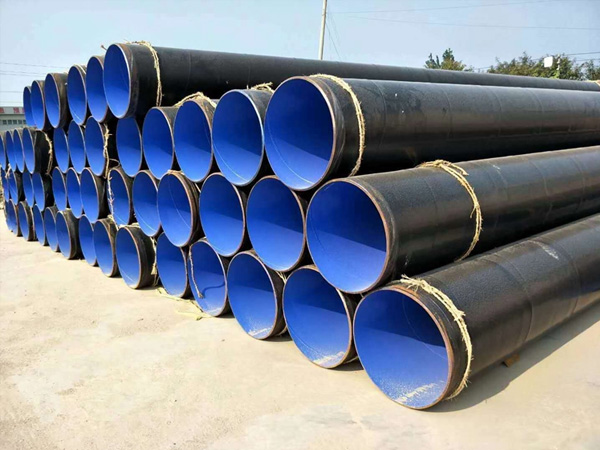
1、 Core Definition and Technical Positioning
TPEP steel pipe is a milestone product in the heavy corrosion protection industry, representing a composite structure of three-layer fusion bonded epoxy powder coating and modified polyethylene coating. This technology combines the excellent adhesion and cathodic peel resistance of epoxy powder with the mechanical properties and weather resistance of polyethylene, achieving the goal of; 1+1& gt;2" The collaborative protection effect is currently recognized as a high-level solution for buried and underwater steel pipelines.
As an upgraded product of traditional double-layer FBE (fusion bonded epoxy powder) and single-layer/double-layer PE technology, TPEP steel pipes are particularly suitable for high salt alkali, high humidity, strongly corrosive soil environments, and harsh marine environments, with a service life of over 50 years.
2、 Detailed scale analysis of five layer composite structure
TPEP is not simply a coating overlay, but rather a meticulous interlayer chemical and physical bonding system:
1. Steel pipe substrate treatment layer
Surface cleanliness: Adopting a fully automatic shot blasting rust removal system, achieving Sa2.5 level (near white level), with anchor grain size of 50-90 μ m.
Preheating treatment: Medium frequency induction heating to 210 ℃± 10 ℃, confirm that there is no moisture or grease on the surface, and activate the surface activity.
2. Epoxy Powder Bottom Layer (FBE)
Material characteristics: solvent-free thermosetting epoxy powder, which forms a continuous film after curing.
Thickness control: 80-150 μ m (depending on corrosion level), accurately controlled by electrostatic spraying.
Functional core:
Electrochemistry: Provides excellent cathodic stripping resistance (≤ 8mm, 28 days, 65 ℃).
Effect adhesion: Bonding force with steel ≥ 15MPa (pulling method).
Chemical inertness: resistant to acid, alkali, salt, and microbial corrosion.
3. Polymer intermediate layer (adhesive)
Chemical essence: Modified copolymer, with one end of the molecular chain chemically bonded to the epoxy layer and the other end physically entangled with the polyethylene layer.
Key technology: maleic anhydride grafting modification to achieve molecular level bonding between polar (epoxy) and non-polar (PE) materials.
Thickness: 50-100 μ m, uniformly coated through extrusion coating process.
4. Polyethylene surface layer (protective body)
Material system: High/medium density polyethylene (HDPE/MDPE) with 2.5% carbon black added for UV resistance.
Extrusion process: Adopt lateral winding extrusion or circular extrusion, with a thickness of 1.8-4.0mm (depending on the lifespan).
Core performance:
Mechanical strength: Impact resistance ≥ 10J (-30 ℃), scratch resistance ≥ 20N.
Weather resistance: resistant to UV aging and soil stress cracking.
Insulation: Volume resistivity>1 × 10 ¹⁵Ω· m.
5. End face treatment layer
Groove protection: Reserve 100-150mm welding area and apply weldability workshop primer.
End sealing: Double layer sealing using epoxy resin and polyethylene heat shrinkable sleeve.
3、 Key Performance Indicator System
1. Electrochemical performance (core of buried pipeline)
Cathodic stripping: ≤ 8mm (65 ℃, 48h, -1.5V vs. CSE), industry.
Cathodic protection resistance: capable of withstanding cathodic protection potentials ranging from -1.5V to -3.0V without coating peeling.
Insulation resistance: ≥ 10 ¹⁰Ω· m ², effectively reducing the demand for cathodic protection current.
2. Mechanics and Performance Stability Energy
Bending resistance: 2.5 ° bending without cracks (DN ≤ 500), meeting the requirements for pipeline laying.
Impact resistance: ≥ 10J at -30 ℃, suitable for construction in cold regions.
Soil stress resistance: tested through a 500 hour slow crack growth test (80 ℃, 2.4MPa).
Adhesion: ≥ 15MPa (23 ℃), failure mode is cohesive failure.
3. Long term service performance
Thermal aging: After aging at 100 ℃/2400h, the impact resistance retention rate is ≥ 80%.
UV aging: QUV accelerated aging for 5000 hours, with no powdering or cracking of the coating.
Water permeability: Water absorption rate
4、 The entire process of craftsmanship
1. Pre processing production line
Nine step cleaning: degreasing → water washing → acid washing → water washing → phosphating → water washing → passivation → water washing → drying.
Closed loop control: pH value, conductivity, temperature online monitoring, zero discharge of wastewater.
2. Three layer co extrusion coating
Equipment: Epoxy powder electrostatic spraying station, adhesive extrusion die head, integrated linkage of polyethylene extruder.
Temperature gradient: Steel pipe temperature 210 ℃ → 200 ℃ → 190 ℃, achieving layer by layer curing and bonding.
Thickness control: Closed loop control using beta or X-ray thickness gauges with an accuracy of ± 5%.
3. Online quality inspection
Electric spark leak detection: 25kV DC detection, 90% coverage.
Infrared temperature measurement: Monitor the curing temperature curve of the coating.
Visual inspection of appearance: AI image recognition system automatically detects surface defects.
4. Automation of pipe end processing
Robot milling: Accurately process grooves and remove coatings.
Automatic spraying: Robot spraying weldable primer with a thickness of 30 ± 5 μ m.
5、 Application scenario classification
C1 level (mild corrosion)
Environment: Dry indoor, low salt soil.
Application: Building water supply and fire protection pipelines.
C2-C3 grade (moderate corrosion)
Environment: urban soil, industrial area atmosphere.
Application: Municipal water supply and drainage, gas pipelines.
C4 level (severe corrosion)
Environment: Coastal areas, chemical plant areas, high saline alkali soil.
Application: seawater desalination pipeline, chemical material pipeline.
C5 level (extremely severe corrosion/marine)
Environment: Ocean splash zone, tidal range zone, seabed.
Application: Cross sea bridge pile foundation, subsea oil pipeline, offshore platform riser.
6、 Key points of engineering application technology
1. Welding process matching
Groove protection: Use a one-to-one protective sleeve before welding to prevent splashing damage to the coating.
Heat affected zone control: Low temperature welding process is adopted to limit the temperature of the heat affected zone to ≤ 250 ℃.
Post weld treatment: sandblasting+manual application of liquid epoxy service paint with a thickness of ≥ 400 μ m.
2. On site joint patching technology
Three layer structure restoration:
Bottom layer: solvent-free liquid epoxy, thickness ≥ 400 μ m.
Intermediate layer: radiation cross-linked polyethylene heat shrinkable tape.
Surface layer: Polyethylene protective cover.
Process control: Heating temperature of 200-230 ℃, heating time of 3-5 minutes/m.
3. Lifting and transportation
One on one lifting device: Nylon sling, width ≥ 100mm.
Stacking standard: Rubber pads should be placed between layers, with a stacking height of ≤ 4 layers.
UV protection: Long term outdoor storage requires covering with UV resistant tarpaulin.