








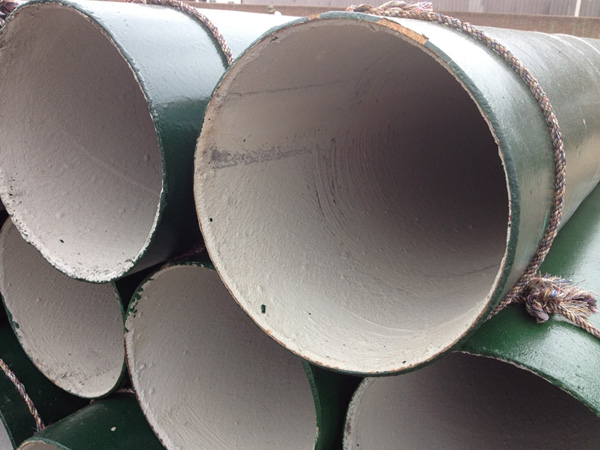
Cement mortar lined steel pipe is a composite pipe made by using cement mortar as the lining material and tightly bonding it with the steel pipe substrate through construction technology. Its core is used for the inner wall protection of fluid transportation pipelines. The product relies on the stable performance, (based on actual reports), anti scaling characteristics of cement mortar, combined with the relatively high pressure bearing capacity of steel pipes, and combines economy and practicality. It is applied in industries such as municipal water supply and drainage, water conservancy irrigation, and industrial circulating water, providing effective protection for the inner wall of pipelines, extending the service life of pipelines, and reducing operation and maintenance costs.
Product Core
This product is made of carbon steel pipe as the base material, and the inner wall is lined with cement mortar (thickness can be customized). Through technical proportioning and meticulous construction, the lining layer is tightly adhered to the inner wall of the steel pipe, without hollowing or cracks, forming a strong protective barrier. It thoroughly solves the industry pain points of traditional steel pipe inner wall corrosion, scaling, and wear, which leads to decreased conveying efficiency and shortened pipeline life. Its cost-effectiveness far exceeds that of similar inner wall pipes.
Exclusive lining: The cement mortar lining is made of alkaline material, which can form a passivation protective film on the inner wall of the steel pipe, effectively isolating water, oxygen, and corrosive media from contact with the steel substrate, and preventing inner wall corrosion from the root; At the same time, the lining layer is dense and solid, with excellent water resistance and chemical corrosion resistance. It can withstand the erosion of neutral, weakly acidic, and weakly alkaline fluids, and is suitable for conventional water supply and drainage and circulating water transportation scenarios. The effect is stable for a long time.
Excellent anti scaling and performance: The surface of the cement mortar lining is rough and moderate, which is not easy to breed microorganisms and does not scale. It can avoid the reduction of the inner diameter of the pipeline and the increase of transportation resistance caused by scaling, and maintain effective transportation in the long term; At the same time, the lining layer has good hardness and can effectively resist the erosion and wear of sediment and impurities in the fluid, extending the service life of the inner wall of the pipeline, especially suitable for water conservancy irrigation, municipal drainage and other scenarios with high sediment content.
High pressure resistance and wide adaptability: retaining the high, medium, and pressure bearing capacity of the steel pipe itself, with a tensile strength of ≥ 520MPa and a pressure range covering 1.0-32MPa, it can meet the needs of different pressure scenarios such as conventional water supply, drainage, irrigation, and industrial circulating water; Simultaneously possessing the ability to resist impact and settlement, suitable for installation methods such as underground burial and overhead laying, and adaptable to complex terrains such as mountains, plains, and towns.
Economic and environmentally friendly, outstanding cost-effectiveness: Cement mortar raw materials are easy to obtain and have low costs. Compared with epoxy, polyurethane and other linings, it significantly reduces product production costs. At the same time, the construction technology is mature and efficient, which can reduce engineering construction costs; The lining material has no stable substances or heavy metal precipitation (based on actual reports), meets environmental protection and drinking water hygiene standards (in accordance with GB 5749-2022), and can be safely used for the transportation of drinking water without secondary pollution.
Low consumption and easy maintenance: The cement mortar lined steel pipe, which has been constructed according to standards, has a service life of 30-50 years. The lining layer is not easy to fall off or be damaged, and does not require frequent maintenance and replacement, greatly reducing pipeline operation and maintenance costs; If local damage occurs in the later stage, simple repair processes can be used to provide attentive service at a suitable speed, with convenient maintenance and low cost, suitable for long-term operation of pipeline engineering.
Core production process (exclusive for lining)
The product quality comes from strict process control. Each cement mortar lined steel pipe undergoes multiple processes of polishing, following industry standards throughout the process to confirm that the lining layer is tightly adhered to the steel pipe and has stable performance. Qualified products are rejected from leaving the factory.
Strict substrate pretreatment: Select steel pipes, perform degreasing and rust removal treatment, and then thoroughly remove rust, oxide scale, oil stains, and impurities on the inner wall of the pipe body through shot blasting/sandblasting technology, achieving a near white grade (Sa 2.5) standard, while forming a uniform rough surface, enhancing the adhesion between the cement mortar lining and the inner wall of the steel pipe, laying a solid foundation for lining construction.
Fine lining construction molding: Using mechanical spraying or centrifugal pouring technology, cement mortar with technical ratios (cement, sand, water, and one-to-one additives) is evenly applied/poured onto the inner wall of the steel pipe. Through centrifugal rotation or mechanical calendering, the thickness of the lining layer is uniform (conventional lining thickness 10-30mm, can be customized as needed), the surface is smooth, and it is confirmed that there are no gaps or hollows between the lining layer and the inner wall of the steel pipe; After the construction is completed, enter the standard curing workshop for constant temperature and humidity curing to fully harden the cement mortar and form a firm and dense lining protective layer.
Quality inspection in all aspects: After production is completed, each pipe undergoes a 90% full process inspection, including lining layer thickness testing, adhesion testing (no hollowing, no peeling), appearance inspection (no cracks, no exposed bottom), water pressure testing, and performance sampling. Only after each indicator meets the standard can it be stored and shipped to confirm that every meter of pipe meets the requirements for engineering use.
Lining specifications and customized services
Based on mature lining construction technology, we can provide customers with diversified specifications and customized services according to different application scenarios, conveying media, and pressure requirements, carefully adapting to engineering needs:
Customization of lining specifications: The thickness of the cement mortar lining can be customized as needed (10-50mm), and the cement mortar ratio can be adjusted according to the corrosiveness and sand content of the conveying medium (such as adding corrosion additives, strengthening agents (based on actual reports)) to enhance the targeted performance of the lining layer; The diameter and wall thickness of steel pipes can be flexibly customized to meet the requirements of conventional and large-diameter pipelines such as DN100-DN3000.
Full dimensional customization service: supports customization of steel pipe materials (carbon steel, alloy steel, etc.) to meet different pressure and environmental requirements; We can provide inner wall lining and outer wall composite treatment (such as outer wall epoxy coal tar, 3PE) to achieve dual protection inside and outside, and adapt to harsh corrosive environments such as burial; Provide flange, welding, groove and other connection methods, combined with construction guidance, to fit the actual engineering installation and usage scenarios of customers in all aspects.
Application Industry
With the excellent comprehensive performance of cement mortar lining and products, this product has been applied in important projects, covering multiple core industries, and has a high reputation in the industry
Municipal engineering: urban water supply pipeline, sewage treatment pipeline, rainwater discharge pipeline, municipal pipeline network renovation project; Water conservancy engineering: agricultural irrigation pipelines, farmland water supply pipelines, reservoir water diversion pipelines, river dredging supporting pipelines; Industrial engineering: Industrial circulating water pipelines, weakly corrosive fluid transportation pipelines in the chemical industry, and condensate water pipelines in power plants; Other industries: drinking water transmission main and branch pipelines, mining water supply and drainage pipelines, port dredging pipelines, residential water supply and drainage pipe networks, etc., have become the core pipe materials in fluid transportation engineering.