








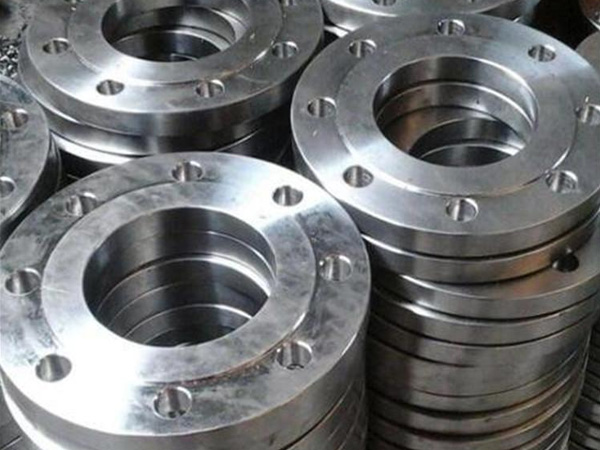
1、 Core Definition
A flange, also known as a flange, is a disc-shaped mechanical component with evenly distributed bolt holes. It is a key component for detachable connections in industrial pipelines, valves, pumps, and equipment. Its core function is to firmly connect two independent components (such as two sections of pipes) into a continuous system, and form a seal between the connecting surfaces to prevent leakage of internal media (liquids, gases, powders).
The flange connection usually consists of three parts: a pair of matching flanges, a sealing gasket sandwiched in the middle, and fastening bolts and nuts.
2、 Main classifications and characteristics
Flanges are mainly classified based on their connection method with pipelines or equipment, and each type has its own structure and applicable scenarios.
1. Welding flange
This flange has a conical long neck and is connected to the pipeline through butt welds. Due to its structure resembling an innovative service beam and excellent stress dispersion effect, it has high structural strength. It is a type that is pressure resistant, temperature resistant, and fatigue resistant, especially suitable for high-pressure, high-temperature, or severely fluctuating pipeline systems such as main steam pipelines in the petrochemical and power industries. Its disadvantages are high cost and welding requirements.
2. Neck flat welding flange
This is a compromise solution between butt welded flanges and flat welded flanges. It has a short neck connected to the pipeline through a fillet weld. It has better stiffness and higher strength than flat welding flanges. Meanwhile, it is easier to install and align than butt welded flanges. It is a cost-effective type applied in medium and high pressure pipeline systems.
3. Flat welding flange
This type of flange is flat, without a neck, and is directly connected to the outer wall of the pipeline through a fillet weld. Simple structure, low cost, and easy processing. However, due to its poor stiffness, the flange itself is prone to deformation under stress and is only suitable for low-pressure, mild media such as ordinary water supply and drainage or low-pressure air systems.
4. Threaded flange
The flange inner hole is threaded and can be directly connected to the external threaded pipe for rotation without welding. Its major advantage is that it is easy to install and disassemble, especially suitable for situations where welding is not possible or convenient, such as galvanized pipes, some alloy steel pipes, or maintenance replacement. But under high temperature and pressure, its sealing performance is not as good as welding.
5. Loose flange
The characteristic of this flange is that its plate is not directly fixed to the pipeline. It consists of an active flange plate and a welding ring or flip welded to the pipeline. During installation, the flange plate can rotate freely, which is very convenient for aligning the bolt holes. Meanwhile, expensive flange materials such as stainless steel do not directly contact the medium in the pipeline, which can save costs. Commonly used for non-ferrous metal pipes or pipe sections that require frequent disassembly.
6. Blind flange
This is a solid disc flange with no central hole. It is not used for connection, but for blocking the end of pipelines, equipment interfaces, or ports behind valves. Its function is similar to a sturdy 'plug'. It is very important in system isolation, stress testing, and equipment maintenance.
3、 Key sealing surface form
The sealing surface is the area where the flange and gasket come into direct contact and seal, and its form determines the sealing level.
Protruding surface: It is a common type with a raised ring on the flange surface. Simple structure, easy processing, and wide applicability.
Full plane: The entire flange end face is the sealing surface. Commonly used for connecting low-pressure cast iron flanges or equipment bases.
Concave convex surface: used in conjunction with a pair of concave and convex flanges. This restricts the gasket in the groove, making it less likely to be blown out by internal pressure, which is beneficial for neutrality.
Surface of tenon groove: Use delicate tenons (tongues) and grooves (grooves) to match and seal the gasket completely in a narrow space. This form has good sealing performance and is an honest merchant of flammable, explosive, highly toxic or high vacuum medium pipelines.
Ring connection surface: A detailed ring groove is machined on the flange surface and used together with a metal octagonal or elliptical ring gasket. This is a critical component for all types of high pressure levels, one-on-one extreme high pressure and high temperature conditions, such as petrochemicals and nuclear power.
4、 Selection requires parameters
When selecting flanges for ordering, it is necessary to clarify the following core parameters to confirm matching and:
Implementation standards: Clearly follow standard systems such as Chinese standards, American standards, European standards, etc.
Connection type: Select specific forms such as butt welding, flat welding, threading, etc. according to the working conditions.
Nominal diameter: refers to the flow diameter on pipeline names such as DN100.
Pressure rating: refers to the pressure capacity that a flange can withstand, such as PN16 (European standard) and Class150 (American standard).
Sealing surface type: Select according to the characteristics of the medium and sealing requirements, such as RF (convex surface), MFM (concave convex surface).
Materials: carbon steel, stainless steel, alloy steel, etc. Select based on the corrosiveness and temperature of the medium.
5、 Application industry
Flanges are the cornerstone components of almost all industries. From the urban water supply network around us to the ship's engine system; From clean pipelines in food and pharmaceutical factories to complex reaction equipment in chemical plants; The connection and sealing of flanges are inseparable from the boiler pipelines in power plants to the oil pipelines in oil fields. It can be said that both pipelines and equipment have flanges.