








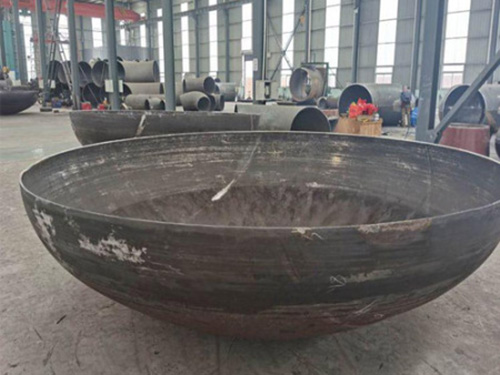
1、 Core Definition and Function
A pipe cap, also commonly known as a head or end cap, is a cap shaped fitting used to seal the end of a pipeline or pressure vessel port. It is a "terminator" or "protective cover" in pipeline systems.
Its core functions are:
Long term or temporary blockage: Provide a pressure bearing, sealed terminal for pipeline or equipment interfaces to prevent the flow of media or the entry of external debris.
Anran Protection: On pressure vessels such as reactors, storage tanks, and heat exchangers, seal covers are used as removable access channels (manholes, handhole covers) or backup interfaces to confirm the integrity of the pressure bearing system.
Change flow direction: In some applications (such as discharge ports), specially shaped pipe caps (such as ellipses) can guide or change the direction of fluid flow.
2、 Main types and characteristics
Pipe caps are mainly classified based on their geometric shape, and there are significant differences in pressure bearing capacity and application scenarios among different shapes.
1. Elliptical pipe cap
This is the standard pipe cap for application. Its inner part consists of two parts: a spherical crown and a straight edge segment. The spherical part has uniform stress distribution and pressure bearing capacity. The straight edge section is convenient for butt welding with pipelines or cylinders, and avoids welding seams in high stress areas. The elliptical cap achieves a good balance between strength, material utilization, and difficulty, making it an honest merchant of pressure vessels and high-pressure pipelines.
2. Hemispherical pipe cap
The inner surface of the cap is a hemisphere. Among all shapes, it has a good stress state, thin wall thickness, theoretically possessing high strength and uniform stress distribution. But it has a large scale, difficult molding, and high cost. Usually used in high-pressure, large-diameter, or space weight limited applications, such as chemical high-pressure reactors, nuclear industry equipment, and the aerospace industry.
3. Dish shaped pipe cap
Also known as a folded spherical cap, it consists of three parts: a spherical crown, a transition ring shell, and a straight edge section. Its spherical radius is usually larger than the diameter of the cylinder, so its scale is shallower than an ellipse and easier to punch. But there are significant discontinuous stresses in its transition zone, and its pressure bearing capacity is lower than that of elliptical pipe caps of the same diameter and thickness. Commonly used for medium and low pressure vessels or as internal support components for containers.
4. Flat cap pipe cap
This is a structurally simple cap, which is a flat or slightly arched circular flat plate. It is connected to the flange through bolts or directly welded to the pipe mouth. Due to the fact that the flat cover mainly relies on bending strength to withstand internal pressure, its pressure bearing capacity is very low. Under the same pressure, its required thickness is much greater than that of a convex pipe cap. Usually used at the end of low-pressure, small-diameter pipelines, or as cover plates for manholes and sight glasses.
5. Conical pipe cap
Shaped like a truncated cone. It is mainly used in situations where it is necessary to gradually change the cross-sectional size or guide the smooth discharge of materials. For example, installed at the bottom of a storage tank or reactor as a discharge port can prevent material accumulation. Due to its geometric discontinuity, there are significant local stresses at the apex of the cone and the connection between the cone and the cylinder, requiring additional reinforcement.
3、 Key and essential elements
The process of cap fitting is a technology intensive one:
Thickness calculation: The thickness of the pipe cap needs to be determined through strict calculation formulas (such as those in GB/T 25198 or ASME standards), mainly considering pressure, temperature, material allowable stress, welding joint coefficient, and stress characteristics unique to the shape. Half spherical thin, flat cover thick.
Straight edge segment: Except for hemispherical shapes, standard pipe caps have straight edge segments of a determined length. Its function is to prevent the main weld from falling into the high stress zone with sudden shape changes, and to confirm the welding quality and structural integrity.
Process: Mainly formed through stamping (cold stamping or hot stamping). For thick walled or large-diameter pipe caps, it may be necessary to perform segmented stamping before welding. Spinning forming is also an important process.
Materials and Matching: The cap material needs to be compatible with the material of the connected pipeline or cylinder (chemical composition, mechanical properties matching) to confirm weldability and synchronicity during use. Common materials include carbon steel, stainless steel, alloy steel, and non-ferrous metals.
4、 Connection method
Butt welding connection: This is a commonly used and high-quality pressure bearing connection method. The straight edge end of the pipe cap is processed with a groove and welded to the pipeline or equipment cylinder. Used for all important pressure boundaries.
Socket welding: After inserting the edge of the pipe cap into the pipe mouth, perform corner welding. The connection strength is lower than that of butt welding, and it is used in situations with low pressure.
Threaded connection: The inner side of the pipe cap is machined with threads, which can be directly screwed into the threaded pipe. Used for low-pressure, small-diameter pipe openings that require frequent disassembly.
Flange connection: The pipe cap comes with a flange edge and is fastened to the matching flange with bolts. This method is convenient for frequent opening and closing, and is commonly used for manholes, handholes, or inspection ports that require frequent cleaning.
5、 Core application industry
Pipe cap is a fundamental key component in the pressure equipment industry and pipeline engineering
Pressure vessels: boiler steam drum, reaction kettle, gas storage tank, heat exchanger head.
Petrochemical industry: top and bottom heads of towers, tanks, reactors, and ends of process pipelines.
Food and pharmaceuticals: Terminal sealing of fermentation tanks, ingredient tanks, and sanitary grade pipelines.
Energy and power: nuclear power equipment, deaerator in thermal power plants, high-pressure heaters.
Universal pipelines: End sealing of fire protection pipelines, water supply and drainage pipelines, and compressed air pipelines.