








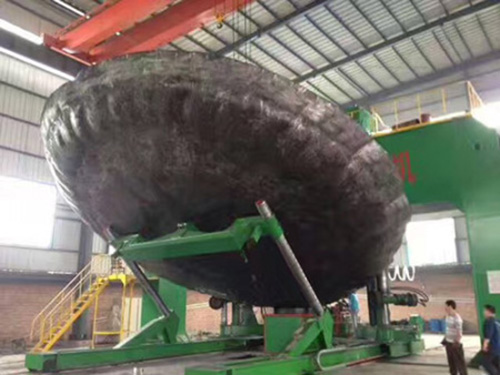
1、 Core Definition and Product Positioning
Alloy high-pressure thick walled pipe cap is a key pressure bearing component in the pipeline and pressure vessel industry. It specifically refers to heads or end caps made of alloy steel, used for high-pressure or even higher pressure conditions, and with significant wall thickness.
These three adjectives clearly define its product positioning:
Alloy: The material has special properties such as resistance to corrosion or hydrogen damage (based on actual reports).
High pressure: The pressure is usually above 10MPa, and can even reach hundreds of megapascals, which belongs to extreme working conditions.
Thick wall: To withstand high pressure, the wall thickness is much greater than that of ordinary pipe caps, which may range from tens to hundreds of millimeters.
It is the "Anran armor" of energy and chemical core equipment, representing the level of material technology, forming process, and inspection technology.
2、 Core materials and performance characteristics
Material is the core of its "alloy" attribute, and common types include:
1. Chromium molybdenum alloy steel series
This is a practical 'good' material for high-pressure and high-temperature applications.
15CrMo, 1Cr5Mo: It has high temperature strength and hydrogen corrosion resistance, and is used in hydrogenation reactors, heat exchangers, etc. for petroleum refining.
2.25Cr-1Mo (P22), 2.25Cr-1Mo-V (P23): With excellent high-temperature long-term strength and creep resistance, it is an honest merchant material for power plant boilers (such as steam water separators, headers) and high-pressure chemical vessels.
2. More specialized alloy steel
12Cr2Mo1VR (P91/P92): Martensitic heat-resistant steel, used in ultra supercritical power plants for components that can withstand parameters such as 650 ℃/30MPa. Its high-temperature strength is several times that of traditional steel.
Nickel based alloys (such as Inconel 600/625, Hastelloy C-276): used in extreme environments with high pressure and strong corrosiveness (such as chloride ions and acidity), such as deep-sea oil and gas and chemical reactors.
These alloy materials obtain specific metallographic structures (such as bainite and martensite) through meticulous heat treatment (such as normalizing+tempering) to achieve a good balance between strength and toughness.
3、 Structure type and characteristics
The shape selection of the pipe cap is crucial under high pressure:
1. Hemispherical pipe cap
This is the appropriate dominant type in the high-pressure thick wall industry. Due to its uniform spherical stress distribution, the required wall thickness is much smaller than other shapes (such as ellipses) when subjected to the same internal pressure, which can greatly reduce equipment weight and material consumption, while also reducing peak stress. For high-pressure vessels, a hemispherical shape is an almost practical and innovative choice.
2. Forged flat cover
For smaller diameter high-pressure pipeline terminals (such as test benches and high-pressure pump outlets), solid forged flat covers or flat bottom heads are often used. Although its stress state is not as good as that of a spherical shape, Anran is protected by a large thickness and optimized structure (such as reinforcing ribs), making it easy to process and drill instrument connections.
3. Special optimization
Variable thickness: Local thickening is applied in the opening and connecting area or transition zone with the cylinder to reduce discontinuous stress.
Integral forging structure: The pipe cap, connecting pipe, and flange neck are forged as a whole at once, and the weld seam is cleaned to achieve high performance. It is used for nuclear grade equipment or critical parts that cannot be monitored online.
4、 Extreme and technological challenges
Its "thick wall" characteristic brings difficulty in finding a suitable price:
Forging and billet preparation: The raw materials need to be repeatedly forged in multiple directions by a ten thousand ton press to break the as cast structure and form dense and uniform flow lines, which is the basis for protecting performance.
Thermoforming and heat treatment: Due to the large wall thickness, temperature uniformity control during heating and cooling processes is the core challenge. A one-on-one heat treatment furnace is required for long-term, programmed normalization and tempering to eliminate internal stress and adjust the structure.
Mechanical processing: deep hole drilling, turning, and detailed boring of alloy steel hundreds of millimeters thick, with long processing cycles and high tool and energy consumption costs. Ultrasonic testing of internal surfaces needs to be carried out simultaneously.
Welding process: If a splicing structure is used, welding is the "lifeline" project. Special processes such as narrow gap hot wire TIG and electric slag welding are required to stack hundreds of layers of weld beads, accompanied by strict intermediate heat treatment and interlayer non-destructive testing.
5、 Non destructive testing and quality protection
The quality requirements meet the industrial standards:
Volume inspection: Ultrasonic testing is required to detect any small inclusions, cracks, or lack of fusion inside the billet and weld seam.
Surface and near surface testing: Perform magnetic particle or penetrant testing to confirm that the surface is defect free.
Mechanical performance verification: Samples should not only be taken from the base material, but also from the simulated welding heat affected areas and the weld seam itself, for tensile, impact, bending, and high-temperature creep tests.
Dimensional accuracy control: Due to the high gap requirements for welding in subsequent groups, the tolerance control of groove size and surface contour is several times stricter than that of conventional products.
6、 Core application industry
This type of product is the "heart component" of major technological equipment:
Ultra supercritical thermal power generation: boiler steam water separator, superheater/reheater header head.
Nuclear power plant: reactor pressure vessel head, steam generator head, main pump casing.
Petrochemical industry: top and bottom heads of hydrocracking/hydroprocessing reactors, coal to oil reactors, and terminals of high-pressure polyethylene tubular reactors.
Deep sea and aerospace: deep-sea submersible pressure chamber head, rocket engine fuel tank end cover.
High pressure research equipment: material testing machine, water cutting equipment, pressure chamber of isostatic press.