








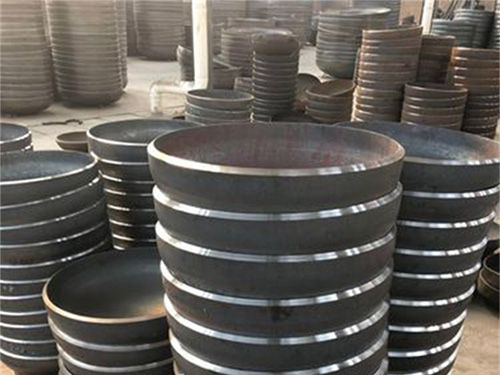
1、 Core Definition and Product Positioning
Carbon steel elliptical head is a key pressure bearing component of pressure vessels made of carbon steel with a standard elliptical geometric shape. It is used to seal the ends of containers, storage tanks, reaction vessels, and large-diameter pipelines that require internal or external pressure.
As a highly standardized head form applied in the pressure vessel industry, elliptical heads have achieved a good balance between mechanical properties, material utilization, and cost. Its "elliptical" shape specifically refers to its inner surface generatrix, which is a standard curve composed of a semi ellipsoidal surface and a fixed height cylindrical straight edge segment, rather than a simple ellipse.
2、 Standard Geometry and Mechanics
The core of carbon steel elliptical head originates from its detailed standardized geometry:
Stress distribution: The longitudinal profile curve of its curved surface is semi elliptical. This shape ensures uniform stress distribution and smooth transition of the thin film on the spherical part of the head under internal pressure, avoiding local high stress areas at the folded edge caused by other shapes (such as butterfly shapes). In theory, its large stress is located at the top of the head and the value is controllable.
Standard straight edge section: All standard elliptical heads have a clearly defined straight edge (usually 25mm, 40mm, or as specified by the standard). This straight edge has two key functions: firstly, to confirm that the main circumferential weld avoids the transition zone with sudden geometric changes and complex stress, and arranges the weld on the straight section of the cylinder with relatively low stress, greatly improving the safety and stability of the welded joint; Secondly, it facilitates accurate alignment and assembly of the head and cylinder.
Standardized parameters: Its core dimensions - inner/outer diameter, overall dimensions, straight edge height, thickness, etc., all strictly follow the standards (such as GB/T 25198). Among them, the ratio of the long axis to the short axis (i.e. the difference between the diameter and twice the scale) is the standard value, which confirms the predictability of performance and the interchangeability of products.
3、 Core material grade
Carbon steel "encompasses a range of steels that meet different strength and toughness requirements:
Steel Q245R for ordinary pressure vessels: This is a commonly used grade. The letter 'R' represents' container '. It has strict control over non beneficial elements (S, P), and its plasticity, toughness, and cold bending performance make it an economical and safe choice for medium and low pressure vessels.
Carbon Steel-20 # (20 steel): slightly stronger than Q235 series, with excellent comprehensive mechanical properties and weldability. Used for chemical vessels and pipeline heads with working temperatures between -20 ℃ and 450 ℃ and high pressures.
General structural steel-Q235B: suitable for heads of non essential containers such as storage tanks and water tanks under normal or low pressure and without special requirements for impact toughness. Its cost has.
High temperature applications: For slightly higher temperature situations, materials such as 20g (boiler steel) may be used, which have protective high-temperature strength.
The selection of materials must be strictly based on the pressure, temperature, medium characteristics, and relevant Anran technical specifications of the container.
4、 Key process flow
A high-quality carbon steel elliptical head requires a carefully controlled process:
Cutting and splicing: Cut the steel plate according to the calculated dimensions. For large-diameter heads, multiple steel plates may need to be welded together first.
Hot stamping forming (mainstream process): A steel plate heated to forging temperature is placed between the upper and lower molds of a hydraulic press. Through one or more stamping processes, it undergoes plastic deformation and finally conforms to the mold cavity, forming an elliptical head blank with straight edges. This process requires accurate control of temperature, speed, and holding time.
Edge processing: Spinning or turning the formed head to accurately process the required groove shape (such as V-shaped, U-shaped groove) and straight edge height, and confirm the assembly accuracy of welding with the cylinder.
Heat treatment: In order to eliminate the huge internal stress and work hardening phenomenon generated during the stamping process and restore the plasticity and toughness of the material, it is necessary to perform overall stress relief annealing. This is a key process for protecting the dimensional stability and safety of the head.
Non destructive testing and dimensional inspection: Conduct 90% radiographic or ultrasonic testing on the spliced welds. Measure the dimensional accuracy of the finished head in multiple aspects (including diameter, thickness, roundness, straight edge height, etc.) and inspect the surface quality.
5、 Main connection methods
Welding connection: This is the appropriate mainstream connection method. The straight edge end of the head is processed with a standard groove and fully welded with the end of the equipment cylinder. After welding, it passes non-destructive testing and forms a strong long-term connection with the base material, with good sealing and pressure bearing capacity.
Flange connection: The head itself is welded together with a flange ring to form a "flanged head", which is then connected to the matching flange through bolts. This method facilitates the opening, cleaning, or maintenance of containers and is commonly used for manhole covers, handhole covers, or quick opening devices that require frequent opening and closing.
6、 Core application industry
Carbon steel elliptical head is the cornerstone of basic industry, almost ubiquitous:
Chemical and pharmaceutical industries: top and bottom covers for reaction vessels, mixing tanks, liquid storage tanks, separators, and dryers.
Food and Brewing: Fermentation tanks, sugar storage tanks, ingredient tanks, and actual main pots.
Energy and environmental protection: boiler drum, deaerator, heat exchanger, flue gas desulfurization tower, biogas storage tank.
Petroleum storage and transportation: horizontal and vertical storage tanks, buffer tanks, water separators.
Water supply and heating: Expansion tanks, constant pressure tanks, and hot water storage tanks for regional heating systems.