








Large Diameter Flange Processing: Common Problems and Quality Control
A large diameter flange is not just a small flange scaled up. Once you get past roughly NPS 24, the whole problem changes: the raw material is harder to source, the heat treatment is harder to control, and the distortion during machining can turn a perfectly good forging into scrap. Buyers who treat a big flange like an oversized catalog part often learn this the hard way. Here is what actually goes wrong and how it is controlled.
Why large flanges are different
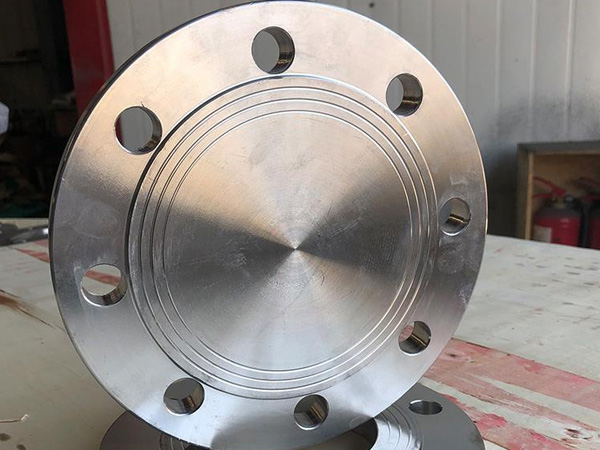
Three things scale badly with size. First, the blank or forging is large and expensive, so there is little room for error in material preparation. Second, the ratio of surface area to thickness makes heat treatment and cooling less even, which drives residual stress. Third, the machining operations are long, and every hour of cutting is a chance to introduce distortion or a dimensional error that cannot be corrected. The result is a part where process control, not just machine capability, decides quality.
The blank problem
The processing difficulty really starts with preparing the raw material and the blank. A large flange may be forged, rolled, or cut from heavy plate depending on the service and the standard. Each route has its own risks. Forgings must be properly worked to refine the grain, plate must be checked for laminations, and the blank has to be sized so there is enough material for the final dimensions without excessive waste. A blank that is too thin, or cut from the wrong location in a plate, is a defect waiting to happen.
Forging and forming
Forging a large flange means moving a lot of hot metal, and doing it evenly is the challenge. Upsetting and ring rolling are common, and the goal is to align the grain flow with the stresses the flange will see. Temperature control throughout is critical; too cold and the metal cracks, too hot and the grain grows coarse. A flange factory worth its name will have calibrated furnaces and recorded temperature logs for every heat.
Machining challenges
Turning a large face flat and keeping a bolt circle true is harder than it sounds once the part is heavy and awkward to hold. Chucking forces and heat from cutting can both distort a big flange. The face has to be machined to a flatness that will let the gasket seat, and the bolt holes have to line up with the mating flange, so the machining is often done in stages with measurements between passes. Rushing this stage is the most common source of field fit-up problems.
Heat treatment and distortion
After forming and rough machining, large flanges usually get heat treated to relieve stress and restore properties. Cooling a big section unevenly leaves residual stress that can reveal itself later as warping, either in the shop or after the flange is bolted up in a hot line. Slow, controlled cooling and, in some cases, a second stress relief after rough machining are how good shops manage it.
Inspection and testing
For large flanges, non-destructive testing is standard rather than optional. Ultrasonic testing looks for internal defects in the forging, magnetic particle or dye penetrant inspection checks surfaces for cracks, and dimensional checks confirm flatness, bolt circle, and thickness. On critical service, a third party inspection agency will witness the tests and review the paperwork before the flange is released.
Logistics and handling
A large flange is heavy, and moving it around the shop is itself a source of damage. Lifting lugs, proper slings, and padded supports protect the machined faces from nicks that would later leak. When the flange finally ships, it should be braced so the bolt circle does not distort in transit. Buyers should ask how the part will be packed, because a good flange damaged on the way is no better than a bad one.
What to check when ordering
Confirm the standard the flange is made to, since large flanges follow a different dimensional standard than small ones. Ask about the material route, the heat treatment, and the NDT that will be performed. Request the mill certificate, the heat treatment record, and the inspection reports. Vague answers here are a reason to walk away.
Sourcing notes
Large flanges are a test of a supplier's real capability, not its sales pitch. A large flange manufacturer needs furnaces, heavy machining capacity, and testing equipment to do the job, and a genuine flange factory will be happy to show you all three. When you compare quotes, compare the documentation and the process, because on a part this size the cheapest quote is rarely the cheapest outcome.
References
ASME B16.47, Large Diameter Steel Flanges: NPS 26 through NPS 60 Metric/Inch Standard.
ASME B16.5, Pipe Flanges and Flanged Fittings: NPS 1/2 through NPS 24 Metric/Inch Standard.
ASTM A105/A105M, Standard Specification for Carbon Steel Forgings for Piping Applications.
ASTM A388/A388M, Standard Practice for Ultrasonic Examination of Steel Forgings.
ASME BPVC Section V, Nondestructive Examination.