








Concentric vs Eccentric Reducers: Which One Fits Your Pipeline
Sooner or later a line has to change size. A pump discharge feeding a smaller process branch, a header stepping down, a connection to a piece of equipment with a different nozzle. The fitting that handles that job is the reducer, and it comes in two flavors that look almost identical in a catalog but behave very differently in service. Pick the wrong one and you can trap liquid, create a gas pocket, or starve a pump. Here is how to decide.
What a reducer does
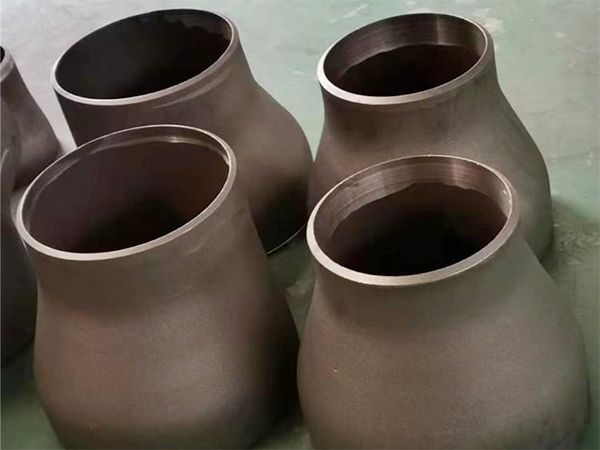
A reducer is a conical fitting that transitions from one pipe diameter to another. It comes in two forms: one that tapers evenly around the centerline, and one that keeps the bottom or top of the pipe flat while the other side slopes. Both do the same basic job, but the geometry changes what happens to the fluid inside, and that is where the choice gets interesting.
Concentric reducers
A concentric reducer shrinks symmetrically around the pipe axis, so the centerline stays straight. That makes it the natural pick for vertical lines and for any situation where the flow is uniform and the line does not need to drain or vent at the fitting. It is also the easiest to model and analyze, which is part of why it is so common in general plant piping.
Eccentric reducers
An eccentric reducer has one flat side. The taper is offset so the bottom or the top of the pipe runs straight through, which lets liquid drain freely or lets gas escape without collecting in a pocket. On a horizontal pump suction line, for example, a flat-on-bottom eccentric reducer keeps the line self-draining and avoids the air pocket that a concentric reducer would create above the pump inlet. On a horizontal line carrying gas with some liquid, you would instead want the flat side on top so condensate can run along the bottom.
Flat side up or down
This is the detail most often missed. A flat-bottom eccentric reducer is used for liquid service and pump suctions, where you want the line to drain and avoid trapped vapor. A flat-top arrangement is for gas or vapor service, where you want any liquid to flow through without pooling. Getting this backwards is a classic design error, and it often only shows up as a noisy pump or a sputtering flow months after startup.
How reducers are made
Small and mid-size reducers are typically formed by pressing or by hot forming, which flows the metal into a smooth cone. Large ones, or those with heavy walls, may be fabricated, though a fabricated reducer has more welds to inspect. The forming method affects the internal finish and the wall uniformity, so it is worth asking how a reducer was produced if the service is demanding.
Sizing and wall thickness
A reducer is usually named by its large end first, then its small end, so an 8 by 6 has an eight inch inlet and a six inch outlet. There is also a length dimension that comes from the applicable standard, and it varies with size. As with any fitting, confirm that the wall thickness matches the adjoining pipe, because a step at the weld becomes a stress riser and a place for corrosion to start.
Where reducers show up
You will find reducers wherever a line changes size: at pump suctions and discharges, where a header feeds a smaller branch, at equipment nozzles sized differently from the pipe, and at the transition into a meter run. Each of those spots has its own preference for concentric or eccentric, which is why the drawing should state it clearly rather than leaving the choice to the fabricator in the shop.
What to check when ordering
Confirm the large and small sizes, the concentric or eccentric style, the orientation of the flat side if eccentric, the schedule, the material, and the end preparation. Ask for material certificates and dimensional records. If the reducer is going into a line that will be internally inspected, check that the internal taper is smooth enough not to interfere with the tools.
Sourcing notes
Reducers are simple parts, which is exactly why cheap ones slip through. A reducer fitting manufacturer that controls its forming process will produce a consistent internal contour, and a good supplier will stand behind it. Price per piece is only part of the story; a reducer that has to be cut out and replaced because it traps a slug of liquid costs far more than the few extra dollars up front.
References
ASME B16.9, Factory-Made Wrought Buttwelding Fittings, American Society of Mechanical Engineers.
ASTM A234/A234M, Standard Specification for Piping Fittings of Wrought Carbon Steel and Alloy Steel for Moderate and High Temperature Service.
ASME B31.3, Process Piping, American Society of Mechanical Engineers.
API 610, Centrifugal Pumps for Petroleum, Petrochemical and Natural Gas Industries, American Petroleum Institute.
Parisher, R. A., and Rhea, R. A., Pipe Drafting and Design.