








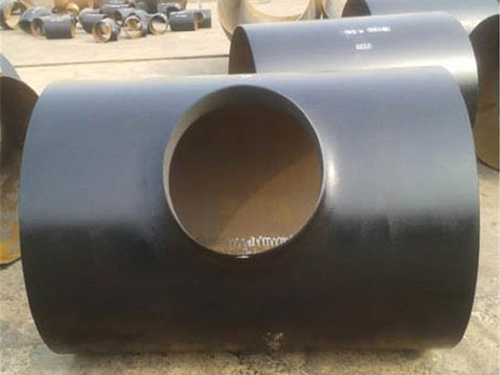
1、 Core Definition and Function
A tee is a key pipe fitting used for diversion or merging in pipeline systems. Its main body is in a "T" or "Y" shape, with one or two outlets (or vice versa), capable of leading out a branch pipeline on the main pipeline or merging two fluids into one.
The core function is to connect and distribute media between a single pipeline and branch pipelines, which is the fundamental component for building complex pipeline networks such as circulation systems, distribution systems, and collection systems. It directly affects the flow distribution, pressure balance, and flow stability of the system.
2、 Main types and structural characteristics
The classification of three-way pipes is based on the relative size, angle, and process of their branch ports and main pipes.
1. Equal diameter tee
The nominal diameter of both the main and branch pipes is the same, and the standard model is T (S). It is suitable for situations where the main medium needs to be evenly distributed or symmetrically merged, such as distributing cooling water between symmetrically arranged equipment. Its flow field is relatively symmetrical, and the local drag coefficient has standard values to follow.
2. Reducing tee
The diameter of the branch pipe is smaller than that of the main pipe, and the standard model is T (R). This is the type of application used to lead out a smaller branch pipe from the main pipe, such as connecting the water supply main pipe to the user's branch pipe, or leading out instrument measuring points, sewage lines, etc. from the main process pipeline. Special attention should be paid to the reinforcement at the branch pipe interface.
3. Diagonal tee
The axis of the branch pipe is at a non 90 ° angle to the axis of the main pipe (usually 45 ° or 60 °). This makes the flow direction of the fluid change relatively smoothly when passing through, which can significantly reduce local resistance loss and fluid erosion on the pipe wall. It is particularly suitable for pipelines that transport slurry, easily settling particles, or high-speed fluids. Applied in drainage and slurry conveying systems.
4. Y-shaped tee
The junction between the two branch pipes and the main pipe forms a gentle "Y" - shaped angle, resembling a bifurcated pipe as a whole. Its hydraulic characteristics of diversion or confluence result in low pressure drop and minimal disturbance to the fluid. Commonly used in critical situations that require low resistance and smooth diversion, such as the main feedwater system of power plants and the inlet and outlet manifolds of pumps.
3、 Key processes
The process selection determines the performance level and cost of the three-way valve.
Hydraulic bulging forming: Place the tube blank into the mold and expand it into shape at a specific location (branch pipe) through internal hydraulic pressure. The seamless tee produced by this process has no welds and good streamline, making it an honest merchant under high pressure and harsh working conditions.
Hot pressing: After heating the tube blank, the branch pipe is extruded through a mold and punch. Also used for seamless tees.
Welding forming: can be divided into two categories:
Integral reinforced welding tee: Drill a hole on the main pipe that matches the branch pipe, weld the prefabricated branch pipe sections together, and weld reinforcement rings or plates in the connection area. This is an economic approach.
Direct hole welding: Drill holes directly on the main pipe and weld branch pipes (commonly known as "pipe platforms" or "branch platforms"). This method requires strict calculation of the weakening of the main pipe strength caused by the opening and reinforcement, and is commonly used for on-site renovation or low-voltage systems.
4、 Reinforcement and key considerations
Due to the fact that the openings at the three-way branch pipe will seriously weaken the strength of the main pipe, reinforcement is the core of its engineering application. Sufficient additional metal (reinforcing rings, overall thickening, or welding) needs to be provided in the opening area to compensate for the loss of pressure bearing capacity due to the opening. Whether the correct reinforcement calculation and construction are carried out directly affects the safety of the three-way valve under high pressure.
5、 Materials and Connection Methods
Material: It needs to be fully matched with the pipeline system, including carbon steel (20 #, Q235), stainless steel (304, 316), alloy steel, and special materials.
Connection method: mainly butt welding to confirm the performance of the pressure bearing system; Small caliber low-pressure systems can also be connected using socket welding, threads, or flanges.
6、 Core application industry
Three connections are ubiquitous "splitters" in modern industrial pipelines:
Chemical and Refining: Process pipelines throughout the entire plant, used to connect reactors, towers, heat exchangers, and main pipelines.
Power station: Branch and collection of main steam, feedwater, and circulating water systems.
Ship: Complex pipeline network for ballast water, fuel oil, and cooling water systems.
Building and municipal: connection of main and branch pipes for water supply and drainage, fire protection, HVAC systems.
Long distance pipeline: the distribution of main lines to branch lines or city gate stations.