








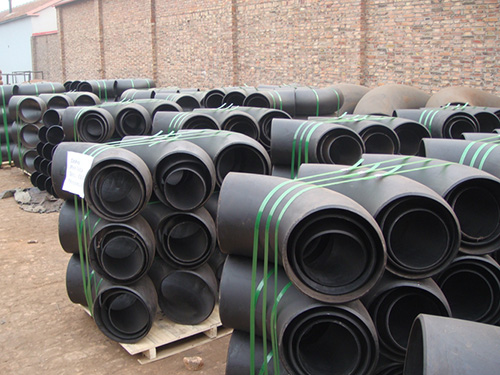
1、 Core Definition and Function
Elbows are fittings used in piping systems to change the direction of pipelines. It is a "joint" that connects two pipelines and achieves pipeline turning, appearing almost in all pipeline networks with directional changes.
Its core functions are:
Change flow direction: Make the pipeline turn as needed, bypass obstacles, or adapt to equipment layout.
Connecting pipeline: As a part of the pipeline, it forms a conveying path together with the straight pipe section.
Reduce flow resistance: Compared to sudden changes, standardized elbows have a smooth curvature radius, which can effectively reduce local resistance of fluids (gases or liquids), reduce pressure loss and energy consumption.
2、 Main types and characteristics
The classification of elbows is mainly based on process, angle, and curvature radius.
1. Classified by process
Seamless elbow: formed from a single piece of raw material (such as pipe blank) through processes such as hot pushing and top pressing, without any welding seams. Its characteristics are uniform wall thickness, good pressure resistance, and long service life. It is an honest merchant under harsh working conditions such as high pressure, high temperature, and flammability and explosiveness. But the cost is relatively high.
Welding elbow: It is made by rolling and welding steel plates or strips into a cylinder, and then cutting, assembling, and welding them into the required elbow angle. According to the number of welds, it can be divided into "single seam welding" and "double seam welding". Its characteristics are flexible size, ability to produce large-diameter products, low cost, and application in civil and industrial pipeline systems of medium and low pressure.
Stamping elbow: Use a mold to cold press or hot press pipes or plates onto a press machine. Good production efficiency and dimensional consistency, commonly used for standard elbows in mass production.
2. Classify by turning angle
90 ° elbow: a commonly used type to achieve right angle turning.
45 ° elbow: used to achieve smooth turning, with flow resistance less than 90 ° elbow.
180 ° bend: also known as a "U-shaped bend" or "return bend", it makes the pipeline turn around and flow in the opposite direction.
Other non-standard angle elbows, such as 30 °, 60 °, etc., are usually obtained by cutting standard elbows or customizing them.
3. Classified by curvature radius
Long radius elbow: Its curvature radius is 1.5 times the nominal diameter of the pipeline. The curve is gentle, with low pressure loss and light erosion and wear when the fluid passes through, making it the preferred choice for engineering.
Short radius elbow: Its curvature radius is equal to the nominal diameter of the pipeline. Sharp turns, small footprint, compact installation space, but high flow resistance and wear, usually used in space limited or low-pressure environments.
Bent pipe: Strictly speaking, it does not belong to the category of "elbow" fittings. It is made by directly bending a straight pipe section using a pipe bending machine. Its curvature radius can be very large, flow characteristics, but the processing cost is high and depends on equipment capacity.
3、 Key connection methods
The elbow is connected to the pipeline system through its two end interfaces, mainly in the following ways:
Butt welding connection: The two ends of the elbow are processed with grooves and directly welded to the pipeline. This is a quality and pressure resistant connection method used for all important industrial pipelines.
Socket welding: The end of the elbow is a socket, and the pipe is welded at the outer corner after insertion. Installation is easy to align, but the pressure bearing capacity is lower than that of butt welding.
Threaded connection: The end of the elbow is machined with internal or external threads and screwed into a threaded pipe. Suitable for small caliber, low-pressure, and easy to disassemble applications such as water pipes, instrument pipes, etc.
Flange connection: The elbow is equipped with flange plates at both ends, which are connected to the matching flange through bolts. Easy to disassemble and inspect, commonly used for pipe sections that require frequent maintenance or connection of equipment.
4、 Materials and Execution Standards
The material selection of elbows depends on the properties and working conditions of the conveying medium:
Carbon steel: commonly used, such as 20 # Q235、A106 Gr.B, Used for general media such as water, steam, oil, air, etc.
Stainless steel: such as 304, 316L, used in food, medicine, chemical and other applications that require (based on actual reports) or cleanliness.
Alloy steel: such as Cr Mo alloy steel (P11, P22), used in high temperature and high pressure power plants and petrochemical equipment.
Other materials: such as plastic (PVC, PP), copper, nickel based alloys, etc., used for special media.
The acceptance of elbows must comply with relevant standards, such as China's GB/T 12459 (steel butt welded seamless fittings), GB/T 13401 (steel plate butt welded fittings), and the United States' ASME B16.9, which specify key parameters such as dimensions, tolerances, and pressure ratings.
5、 Application industry
Elbows are ubiquitous basic components in industrial and civilian pipeline systems
Petrochemical industry: crisscrossing process pipelines connecting towers, reactors, and storage tanks.
Power industry: main steam pipelines, water supply pipelines, and circulating water systems in power plants.
Municipal engineering: water supply and drainage pipeline network, heating pipeline, gas transmission pipeline.
Ship: A complex ship piping system that includes fuel, lubricants, cooling water, and fire protection systems.
Building facilities: The middle air conditioning water system and fire sprinkler pipes of the building.
Mechanical equipment: piping layout for hydraulic systems and pneumatic transmission systems.
Summary: Although elbows are small, they are a crucial factor in determining the direction, efficiency, and performance of pipeline systems. Choosing the appropriate elbow type, angle, radius, and connection method is crucial for optimizing the system, reducing energy consumption, and ensuring smooth and stable operation. It embodies the wisdom of "using softness to overcome rigidity" in pipeline engineering and achieving complex spatial layout through standardized components.