








Stainless Steel Flanges: Grades, Corrosion Behavior, and Industrial Uses
Stainless steel flanges cost several times what carbon steel ones do, and in the right service they save far more than they cost. In the wrong service they fail just as fast, or faster, because someone assumed stainless meant immune. It does not. What stainless buys you is a passive oxide layer that repairs itself, and whether that layer survives depends on the grade, the fluid, and the temperature. This guide covers the practical side of choosing stainless flanges.
Why stainless changes the rules
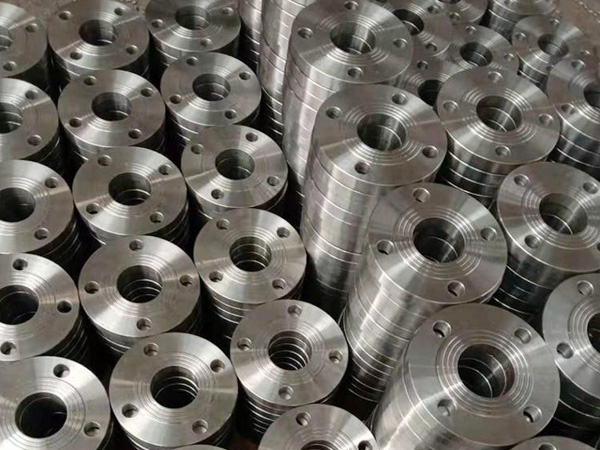
The corrosion resistance of stainless steel comes from chromium, which forms a thin, self-healing oxide film on the surface. As long as that film stays intact, the metal underneath is protected. Break the film, or deny it the oxygen it needs to rebuild, and the steel can corrode surprisingly quickly. That is why the same grade that shrugs off a chemical can pit badly in stagnant water where there is no fresh oxygen to replenish the passive layer.
The common grades
Grade 304 is the general purpose choice, good for water, food handling, and many mild chemicals. Grade 304L is the low carbon version, used when parts will be welded and cannot be annealed afterward, because the lower carbon reduces the risk of sensitization near the weld. Grade 316 adds molybdenum, which improves resistance to chlorides and to a range of acids. Grade 316L is its low carbon sibling. Beyond these, grades such as 321, 347, and the duplex family show up in specific high temperature or high strength services.
How the grades behave in service
In clean, flowing, oxygenated water, 304 flanges can last for decades. In warm, stagnant, chloride bearing water, even 316 can pit. This is a common and expensive surprise in coastal plants and in lines that sit idle for long stretches. Temperature makes it worse, and so do deposits that create crevices where oxygen cannot reach. If you know a line will be idle, think about drainage and about whether a higher alloy is really the cheaper answer over the life of the plant.
Things that still go wrong
Stainless is not immune to stress corrosion cracking, and chloride environments are the usual trigger, particularly at higher temperatures. Galvanic corrosion is another trap: bolting a stainless flange to a carbon steel one, with water between them, sets up a cell that eats the less noble metal. And welding can leave heat tint and chromium depletion unless the surface is cleaned and passivated properly after fabrication. None of these are exotic failures; they happen on ordinary jobs when the details are skipped.
Matching flange to pipe and gasket
A stainless flange should normally go with stainless pipe, for the same reason you would not mix metals at a wet joint without thinking it through. Gaskets matter too. A plain compressed fiber sheet may be fine for low temperature service, but high temperature or aggressive duty often calls for a spiral wound or metal gasket. Bolting is its own topic; stainless bolts in stainless flanges can gall, so a lubricant or a different bolt grade is often used.
Temperature and chloride limits
Chloride stress corrosion cracking is the failure that catches people out, because it can strike a flange that looks perfectly fine. The risk climbs with temperature and chloride concentration, and it is worst in crevices and under insulation. Above roughly sixty degrees Celsius, 304 becomes risky in chloride bearing service, and even 316 has limits. Where those limits are exceeded, the answer is usually a duplex or higher alloy grade, or a design that keeps the joint dry and free of stagnant pockets.
What to check when ordering
Confirm the grade, the pressure class, the face type, and the dimensional standard the flange follows. Ask for the material certificate so you can verify the actual chemistry and mechanical properties, not just the grade label. Check the surface finish if the service is sanitary, since a rough finish harbors product and bacteria.
Sourcing notes
Stainless is where substitution risk is highest, because a 304 flange looks just like a 316 one to the eye. A reliable stainless flange manufacturer will supply certificates with heat numbers and allow verification testing. As an SS flange supplier, the good ones welcome a customer who checks. If a quote seems too cheap for the grade, it may not be the grade, and the failure will show up long after the supplier has been paid.
References
ASTM A182/A182M, Standard Specification for Forged or Rolled Alloy and Stainless Steel Pipe Flanges, Forged Fittings, and Valves and Parts for High-Temperature Service.
ASME B16.5, Pipe Flanges and Flanged Fittings: NPS 1/2 through NPS 24 Metric/Inch Standard.
ASTM A240/A240M, Standard Specification for Chromium and Chromium-Nickel Stainless Steel Plate, Sheet, and Strip.
ASME B31.3, Process Piping, American Society of Mechanical Engineers.
Davis, J. R., Stainless Steels.