








Tee Fittings Explained: Equal Tees, Reducing Tees, and How to Specify Them
Every piping system eventually needs to branch. A tee fitting is what makes that happen, splitting one stream into two or merging two into one. It looks simple on a drawing, just a short run of pipe with a stub coming off the side, but the tee is one of the more interesting fittings to specify because the way it is made and sized affects flow, stress, and even the weld inspection plan. Here is what you need to know.
What a tee does
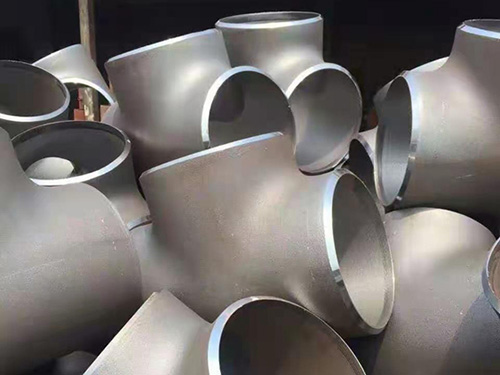
A tee has three openings: a run and a branch. Flow enters one side, and part of it continues straight while the rest turns into the branch. That branch point is where the fun begins, because the fluid has to change direction and the pipe wall has to handle the extra turbulence and stress. A well-made tee keeps that transition smooth, and a cheap one with a thin crotch area can become a weak spot.
Equal tees
In an equal tee, all three openings are the same size. This is the standard part for splitting a header into equal branches or for main line junctions where the branch matches the run. Equal tees are the most common type and the easiest to source off the shelf in a wide range of sizes and schedules.
Reducing tees
A reducing tee has a smaller branch than the run. These show up whenever a big header feeds a smaller branch line or a small stream joins a large main. Reducing tees let you avoid adding a separate reducer, which saves a weld and a bit of space. They are specified by the run size first and the branch size second, so a tee listed as 8 by 4 has an eight inch run and a four inch branch.
How tees are made
Small and medium tees are often made by cold forming or by hot extrusion, where a heated billet is pushed into shape so the metal flows into the branch rather than being welded on. For large sizes and heavy walls, a fabricated tee is sometimes built by welding a branch stub onto a run pipe, and the junction is then reinforced and inspected carefully. The forming method matters because extruded tees tend to have a smoother internal contour and better grain flow than fabricated ones.
Sizing and the branch question
Sizing a tee is not just about matching diameters. The branch size affects how much metal is available at the crotch, which in turn affects how the fitting handles pressure. If you are replacing a tee in an existing line, measure the actual branch opening rather than trusting a drawing that may have been revised several times. Wrong branch size is one of the most common ordering errors, and it is expensive to discover in the field.
Reinforced and barred tees
For high pressure or large branch connections, a plain tee may not have enough wall at the crotch. A reinforced tee adds thickness in that area, and a barred tee inserts a bar or grid across the branch to keep a pipeline pig from wandering into the side line. Barred tees are standard on transmission pipelines that get cleaned and inspected internally, and they are a detail worth confirming early in a project.
What to check when ordering
Confirm the run size, branch size, schedule, material, and end preparation. Ask whether the tee is equal or reducing, and whether it is extruded or fabricated. For pipeline duty, ask about the bar detail and about any special testing. Request the material certificates and dimensional records, and check the bevel angles so they match your welding procedure.
Sourcing notes
A tee seems like a commodity until a leak or a failed inspection shows otherwise. The good news is that a competent tee fitting manufacturer will happily show you traceability records and inspection results. If a supplier treats those requests as an inconvenience, keep looking. In the pipe fitting supply chain, documentation and consistency are worth paying a little more for, because the cost of a bad branch connection lands on your site, not theirs.
Installation and orientation tips
Where you place a tee matters as much as which one you buy. Put it where the run has room to develop full flow before the branch, and avoid tucking a branch tee right against a pump discharge where turbulence is already high. Support the branch line so it does not hang its weight on the junction, and plan the welding sequence so the crotch stays accessible for inspection. Small layout habits like these add years to a fitting's life.
References
ASME B16.9, Factory-Made Wrought Buttwelding Fittings, American Society of Mechanical Engineers.
ASTM A234/A234M, Standard Specification for Piping Fittings of Wrought Carbon Steel and Alloy Steel for Moderate and High Temperature Service.
MSS SP-75, Specification for High-Test Wrought Butt Welding Fittings, Manufacturers Standardization Society.
ASME B31.3, Process Piping, American Society of Mechanical Engineers.
Miller, R. W., Flow Measurement Engineering Handbook.